
Threshold® Operations Transformation
Turning a Reactive Department Into a Strategic Growth Operation
When I assumed leadership of Creative and Marketing, the department supported Source Naturals, Planetary Herbals and Threshold Enterprises across packaging, retail, ecommerce, advertising, video, sales collateral and internal communications.
The quality of the work was strong. The operation surrounding it was not.
Creative and Marketing had primarily functioned as sales support. If Sales requested something, we produced it. There was no consistent process for evaluating the opportunity, expected return or value to the customer, brand or company.
The approach kept the department busy, but being busy is not the same as being effective.
I set out to rebuild how the department operated, from team structure and agency relationships to spending, technology, workflow and measurement. The objective was straightforward: put our time and resources where they could create the greatest value.

The Cost of Reactive Work
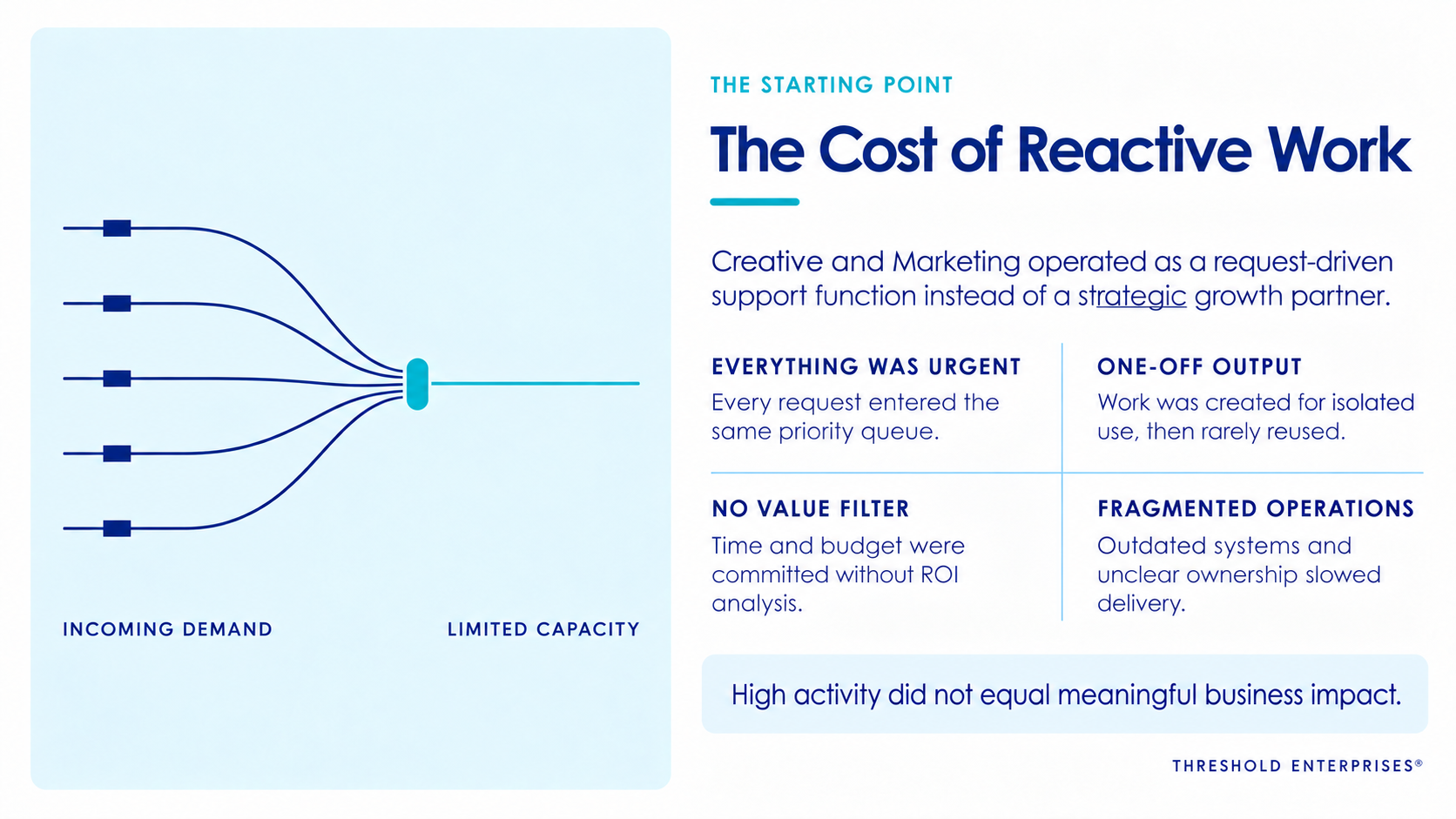
The department had no consistent framework for deciding which requests deserved resources.
Projects frequently arrived with limited lead time, and nearly everything was treated as a priority. Requests moved forward without enough consideration of customer potential, business value or connection to larger company goals.
One-off collateral and assets consumed significant time, even when they were used rarely or produced no discernible return. Work was being created because someone asked for it, not because it was tied to engagement, reach, revenue, trust, authority or another defined outcome.
Templates, standardized processes and centralized asset systems were limited or nonexistent. Too many people influenced workflows they did not fully understand, while outdated technology and an “it has always been done this way” mindset made routine projects slower and more difficult than they needed to be.
The problem was not effort.
It was the lack of a system for directing that effort.
Auditing the Entire Operation
I conducted a formal audit across personnel, agencies, workflows, technology, programs and expenditures.
I looked at what we were doing, why we were doing it, what it cost, who owned it and whether it created enough value to justify the resources behind it.
The audit identified redundant responsibilities, overlapping departments, unnecessary software, underperforming programs and large amounts of work being produced without defined KPIs. It also revealed opportunities to bring agency capabilities in-house and automate processes that had required days or weeks of manual effort.
Every activity was evaluated against several questions:
- Does it create measurable business value?
- Is the return positive, neutral or negative?
- Can the work be eliminated, consolidated or automated?
- Could the same resources produce a stronger result elsewhere?
- Does this capability belong internally or with an outside partner?
I was not looking to make cuts simply for the sake of cutting. I was looking for duplication, waste and work that no longer deserved the team’s time.
That analysis became the foundation for a more focused operating model.
Redesigning the Department
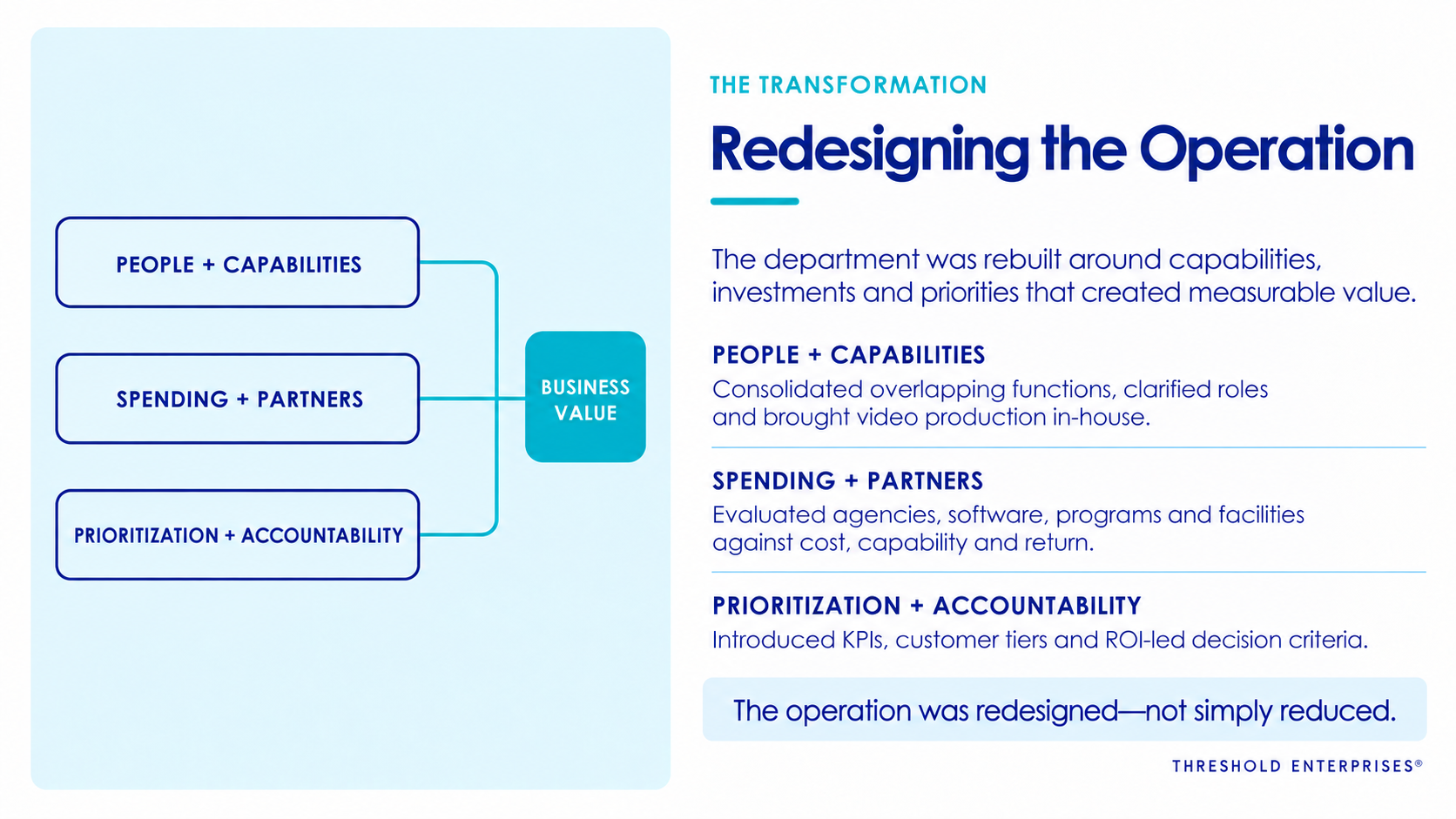
The transformation required restructuring roles, clarifying responsibilities and aligning the team with the capabilities the organization actually needed.
Two overlapping video departments were consolidated into one internal team, allowing us to bring video production fully in-house. A costly fixed studio that no longer matched our needs was decommissioned, unnecessary equipment was sold and production shifted toward a more flexible, mobile model that better supported contemporary digital content.
Agency relationships were evaluated based on business impact, quality, strategic value, cost-effectiveness, capabilities and the three R’s: reliability, responsiveness and return on investment.
Software, programs and recurring expenditures received the same scrutiny. We continued investing where a tool or partner created real value. When something existed primarily because it had always existed, it was reduced, replaced or eliminated.
The standard changed from “we have always done it this way” to “what value does this create?”
Building Infrastructure That Removed Work
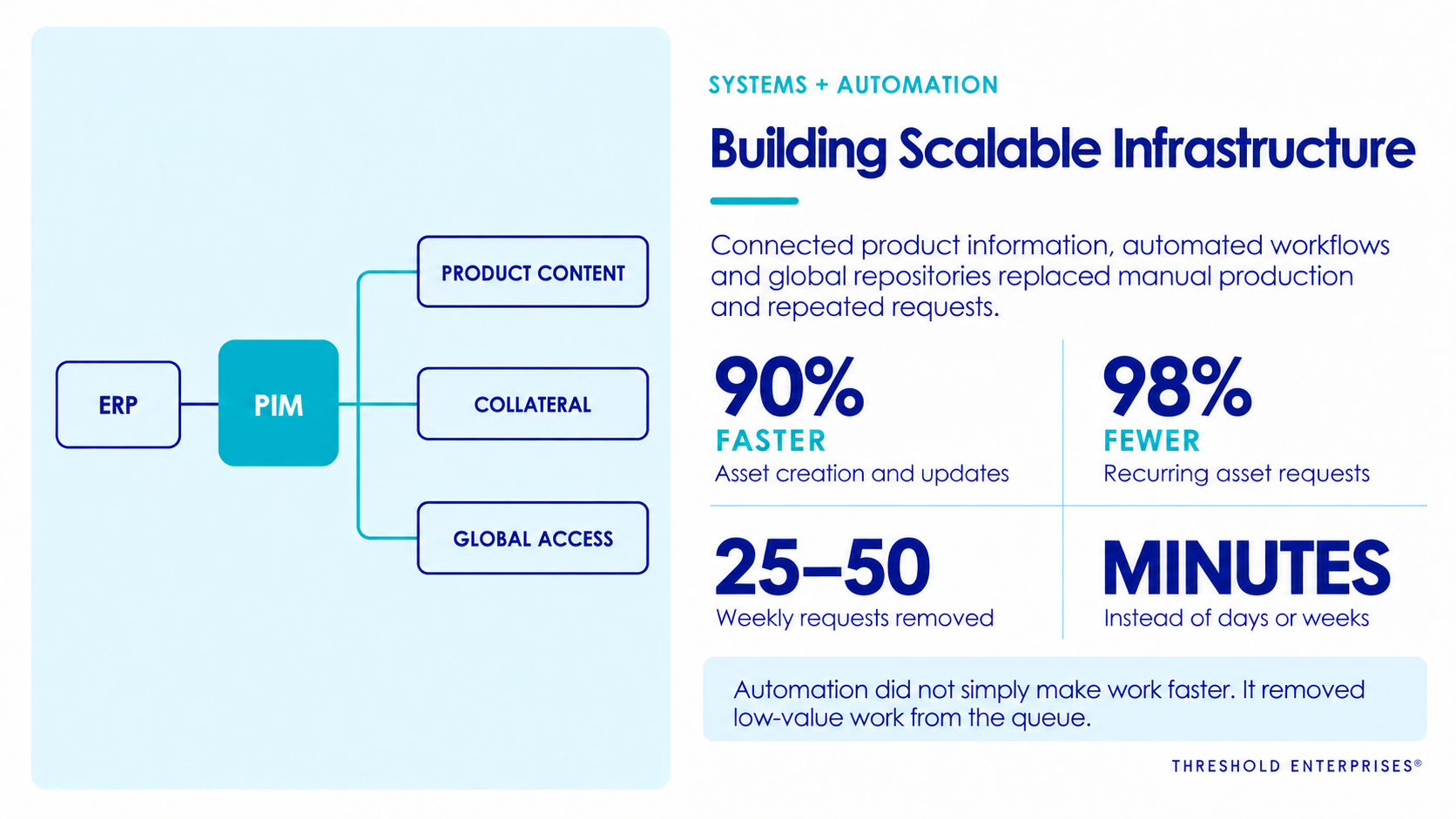
A new product information management platform was introduced and connected with the company’s ERP system.
Processes that previously required days or weeks of manual work could now be completed in minutes, often directly by the person who needed the information. Centralized product content could populate multiple forms of collateral from one source, reducing production churn, errors and inconsistent messaging.
I also established global repositories for frequently requested creative and marketing assets. Internal teams and customers could access current materials without repeatedly asking Creative and Marketing to supply them.
A streamlined update process made asset creation and maintenance approximately 90% faster while ensuring the latest approved versions remained available globally. Incoming asset requests dropped by approximately 98%, eliminating a recurring queue of 25 to 50 requests each week.
Automation mattered because it did more than make the same work faster.
It removed low-value work from the department and gave that time back to the team.
Directing Resources Toward Greater Return
The new operating model also changed how we prioritized projects and customers.
I introduced KPIs across department functions, strengthened ROI evaluation and established a tier-based customer structure. This allowed us to focus more attention on high-value accounts and customers with the potential for double-digit revenue or manufactured-product growth.
Co-op marketing and product-sample allocation were restructured around measurable opportunity rather than historical expectations. Programs with neutral or negative returns were eliminated, reduced or reconsidered. Programs producing positive results were examined for ways to improve their efficiency and impact.
Creative and Marketing became more selective about what we produced and more accountable for why we were producing it.
We stopped treating activity as an outcome.
Measurable Operational Impact
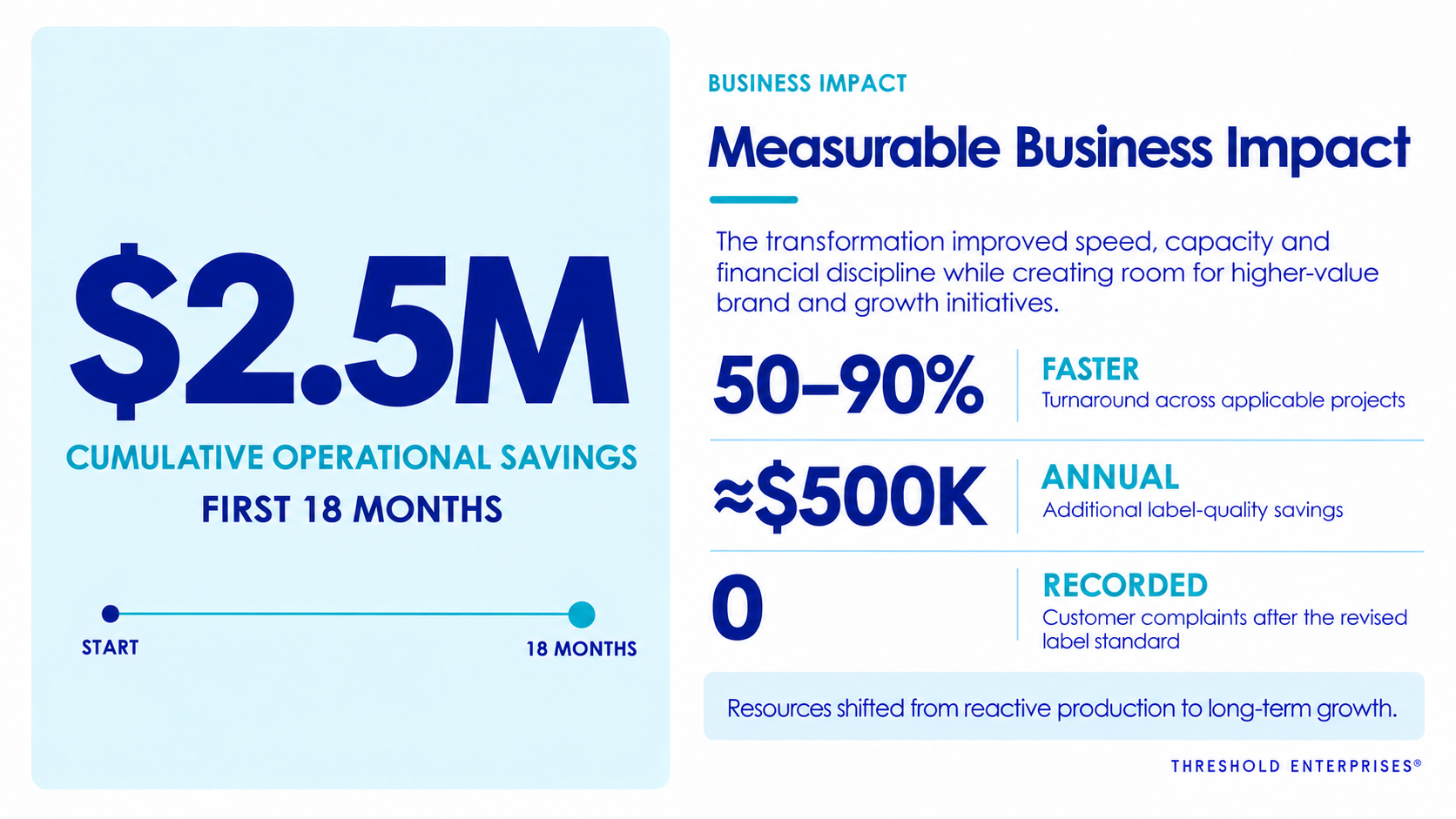
The transformation produced substantial financial and operational results:
- $2.5M Cumulative operational savings during the first 18 months
- 50–90% Reduction in turnaround time across applicable projects
- 98% Reduction in recurring asset requests
- 25–50 Weekly requests removed from the department queue
Savings came from personnel and capability consolidation, reduced facility expenses, equipment resale, program contraction, software reduction, workflow automation and broader improvements in department protocols and resource allocation.
The same operating principles also extended beyond Creative and Marketing.
I helped refine the company’s label-quality review process, contributing to approximately $500,000 in additional annual savings. Labels had previously been rejected for minor imperfections that did not affect customer acceptance. Since the revised standard was implemented, there has not been a recorded customer complaint related to the change.
Leading Change Across the Organization
None of this happened in a vacuum.
In a long-established company, changing familiar processes creates understandable concern. I worked directly with teams and stakeholders to hear those concerns, explain the business rationale and determine whether they reflected resistance to change or a legitimate issue that needed to be addressed.
When a concern identified a real implementation problem, I treated it as something we needed to solve, not something to dismiss.
Changes affecting finances, retailers or other departments were developed collaboratively with executive leadership and key stakeholders. Decisions contained within Creative and Marketing remained under my direct ownership.
I also worked to make proposals clear enough that leadership could make decisions quickly. Findings were generally presented in meetings lasting 30 minutes or less, and most decisions were made in the room without requiring multiple follow-up meetings.
From Production Support to Business Leadership
The transformation gave the department greater capacity, faster execution and a clearer connection to company growth.
The team moved beyond a constant cycle of last-minute production and gained more time for long-term brand development, strategic initiatives and new growth opportunities. Pressure decreased, accountability improved and resources became more closely aligned with work that created measurable value.
This was more than a Creative and Marketing reorganization.
I still care deeply about the quality of the creative work. I also know that the work cannot succeed when the team, process, technology and investment behind it are working against it.
Building the conditions for better work is part of creative leadership too.